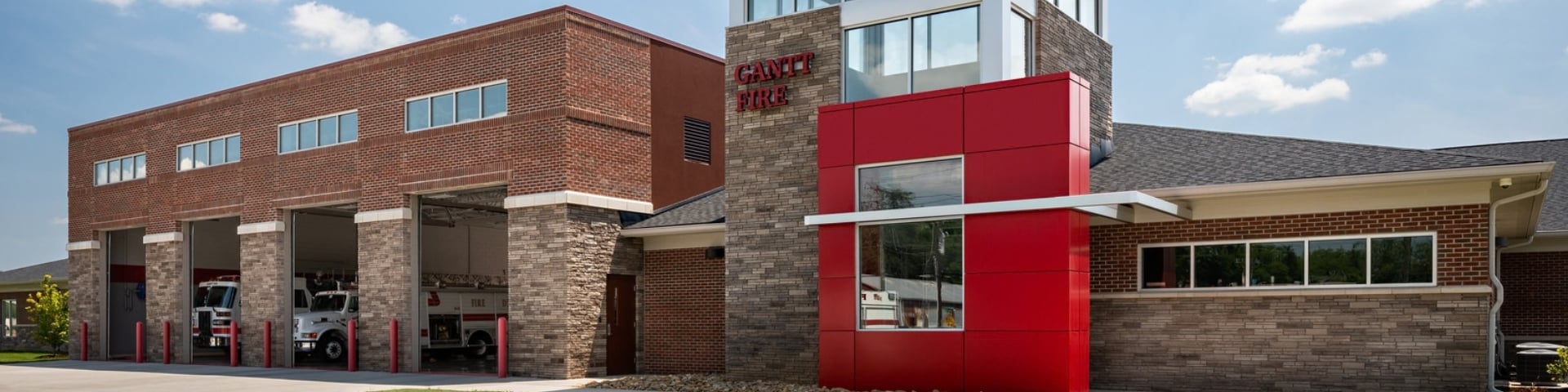
Few buildings ask for more from their materials than fire stations. A firehouse must function as an emergency-response facility, equipment garage, workplace and living space, often 24 hours a day. Materials need to withstand heavy use while helping address fire safety, temperature control, acoustics, maintenance and occupant comfort.
Concrete masonry is uniquely suited to meet many of those demands in a single material.
Fire Protection For The People Who Provide It
The connection between masonry and fire stations begins with the obvious: fire resistance.
Concrete masonry is noncombustible and is widely used in fire walls and barriers because of its ability to withstand fire exposure while helping contain its spread. According to the Concrete Masonry & Hardscapes Association, concrete masonry assemblies can achieve fire-resistance ratings of one to four hours depending on the wall assembly.
Fire resistance was an important consideration at Phoenix Fire Department Station 59, designed by LEA Architects to serve an industrial area that includes a large fuel-storage facility. The 15,000-square-foot, four-bay firehouse needed to protect firefighters and support staff while providing functional, comfortable living and working spaces. Echelon Trenwyth Trendstone ground-face CMUs contribute structural durability and architectural character throughout the station.
LEA said the design team selected masonry in part to contribute to the safety of a “non-combustible building,” while also gaining benefits related to thermal performance, acoustics and long-term durability.
Thermal Mass For Demanding Climates
In Phoenix, heat is another major design consideration. With summer temperatures routinely placing substantial demands on cooling systems, the thermal mass of masonry offers an additional benefit.
“We chose masonry on the interior for its thermal mass properties,” LEA explained. Once cooled, the masonry helps moderate interior temperature swings and reduce demands on mechanical systems. That thermal mass can provide value in fire stations, where occupants are present around the clock, and energy performance matters throughout the day and night.
Controlling Noise Between Work And REST
A fire station combines environments that normally would never share a building. Apparatus bays, equipment, alarms and vehicle activity exist alongside sleeping quarters, offices and communal living spaces. Masonry’s mass can help reduce sound transmission between those areas, an advantage LEA specifically identified in the Station 59 design.
That sound control can help create more comfortable living and sleeping environments without sacrificing the durability required in the station’s working areas.
Designed For Permanence And Flexibility
Fire stations also need to project a sense of permanence within the communities they serve. That goal helped shape the design of Rolling Meadows Fire Station Headquarters #15 and Fire Station #16 in Illinois, designed by Healy Bender Patton & Been Architects with R.C. Wegman Construction.
City officials wanted both buildings to fit their surroundings while conveying a strong, permanent appearance appropriate for civic facilities. The design also called for a combination of loadbearing and non-loadbearing masonry. As senior architect and project manager Scott Rihel noted, “Every fire station design is a response to the owners’ requirements and needs.”
Working with Echelon, the team selected Waterford Stone in London Gray in an ashlar pattern, with graphite Cordova Stone used for trim accents. The combination allowed the architects to carry a consistent masonry aesthetic across different wall conditions, using full-depth units where supported from grade and thin non-loadbearing material where appropriate.
The masonry also helped create architectural details that reinforce the stations’ civic presence, including arched openings, sills, door surrounds and apparatus bay borders. After completion, Rihel said, “The feedback has been overwhelmingly positive.”
Durability For A Building That Never Clocks Out
Fire stations experience constant activity. Apparatus moves in and out, equipment is stored and maintained and crews live and work in the building around the clock.
Concrete masonry stands up well to impact, moisture and everyday wear while requiring relatively little maintenance. Architectural masonry can also serve as a finished interior or exterior surface, reducing the need for additional finish materials while giving designers flexibility in color, texture and form.
The Phoenix and Rolling Meadows projects demonstrate two sides of the same advantage. In Phoenix, masonry helps address fire safety, thermal performance, sound control and comfort. In Rolling Meadows, it combines durability with design flexibility and a lasting civic presence.
For buildings designed to protect the community, masonry offers a fitting combination: fire resistance, strength, long-term durability and architectural character.
Related Content
-

Masonry in Hurricane-Prone Areas
In hurricane-prone regions, buildings face a range of severe weather threats. High winds, flying debris, driving rain,…
-

Masonry Construction for Wind and Debris Safety
High-wind events can threaten a building in more ways than one. Hurricanes and tornadoes create intense pressure…
-
Understanding Fire-Resistance Ratings
One hour. Two hours. Four hours. These durations commonly appear in building specifications as fire-resistance ratings, indicating…
-
Preventing Fire Damage Loss with Masonry
Fire protection in buildings is a critical consideration throughout a structure’s life, but the risk begins well…