
High-wind events can threaten a building in more ways than one. Hurricanes and tornadoes create intense pressure on walls and roofs while also turning ordinary objects into windborne debris capable of penetrating the building envelope.
For buildings in high-wind regions, resilience depends on designing the entire structure to work together. Properly engineered concrete masonry can play an important role in that strategy, providing strength, mass and impact resistance as part of a continuous structural system.
Wind Resistance Starts With The Whole Structure
Wind does not act on one part of a building at a time. Forces placed on the roof have to transfer through the walls and ultimately into the foundation. Concrete masonry construction can be reinforced and connected to create a continuous load path from roof to foundation, helping the building resist lateral forces, uplift and overturning.
Openings are equally important. When a window, door or other exterior component fails, wind can enter the building and increase internal pressure, placing additional stress on the roof and walls. Impact-resistant glazing or protective systems, properly rated doors, strong roof-to-wall connections and a well-designed masonry structure all contribute to maintaining the integrity of the building envelope.
The wall is only one part of the system. Reinforcement, grout, connections, openings and foundations must all be designed for the wind loads expected at the site.
When Debris Becomes A Projectile
Wind pressure is only part of the danger during an extreme storm.
FEMA defines windborne debris as objects propelled with enough force to damage or penetrate windows, doors, walls and roofs. To simulate that threat, current storm-shelter testing uses a wood 2×4 as a test missile.
Under FEMA P-361 (2024) and ICC 500-2023, community tornado safe-room testing uses a 15-pound 2×4. At the highest 250-mph tornado design wind speed, the missile strikes vertical surfaces at 100 mph.
Properly reinforced and grouted concrete masonry assemblies have demonstrated the ability to meet stringent debris-impact criteria used for storm shelters. Research conducted at Texas Tech University and cited by the Concrete Masonry & Hardscapes Association has helped establish masonry wall assemblies as an option for this level of protection.
Masonry In Storm Shelter Design
Concrete masonry is commonly used in residential and community storm shelters because it can be engineered to address both wind pressure and debris impact. FEMA P-361 provides current guidance for the design and construction of safe rooms, while ICC 500-2023 establishes requirements for storm shelters, including structural wind loads, debris-impact resistance, openings, egress and other life-safety considerations.
A resilient masonry building is not automatically a storm shelter. Safe rooms and storm shelters must be specifically designed and constructed to the applicable FEMA guidance, ICC requirements and local building codes.
Built For High-wind Regions
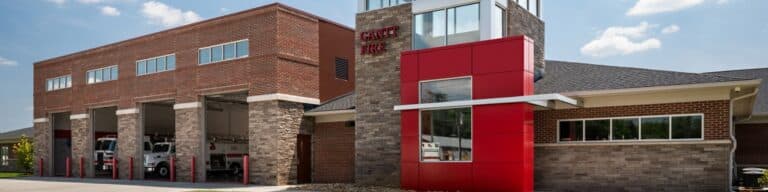
Not every project requires a designated shelter, but the same principles can inform buildings throughout hurricane- and tornado-prone regions. Reinforced structural masonry can help designers address high wind loads while providing the durability, fire resistance and long service life associated with concrete masonry. For schools, healthcare facilities, fire stations, municipal buildings and other essential structures, maintaining the integrity of the building can also help support continuity after a severe weather event.
Echelon structural masonry gives architects performance advantages along with a range of architectural colors, textures and finishes, allowing resilient construction to remain part of the design rather than something hidden behind it.
High-wind resilience is never the result of a single material. It comes from designing the structure, connections and openings to work together. Properly reinforced and engineered masonry can be an important part of that system, helping protect both the building and the people inside it.
Related Content
-

Masonry in Hurricane-Prone Areas
In hurricane-prone regions, buildings face a range of severe weather threats. High winds, flying debris, driving rain,…
-
Why Fire Stations Choose Masonry
Few buildings ask for more from their materials than fire stations. A firehouse must function as an…
-
Understanding Fire-Resistance Ratings
One hour. Two hours. Four hours. These durations commonly appear in building specifications as fire-resistance ratings, indicating…
-
Preventing Fire Damage Loss with Masonry
Fire protection in buildings is a critical consideration throughout a structure’s life, but the risk begins well…